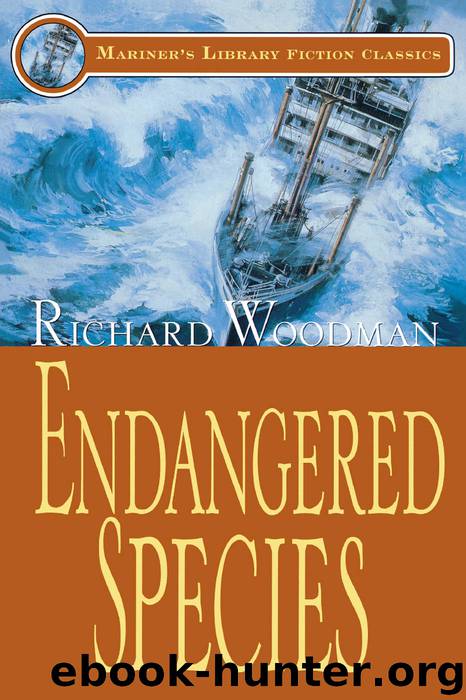
Endangered Species by Richard Woodman
Author:Richard Woodman
Language: eng
Format: epub
Publisher: Sheridan House
Published: 1992-06-28T16:00:00+00:00
CHAPTER ELEVEN
Oil and Water
On the bridge Mackinnon considered what to do next. With the wind on the starboard quarter the Matthew Flinders would slowly move out of the path of the advancing typhoon on a curving course. This was a result of the indraught of the air as it circulated and was drawn towards the eye of the storm. The wind-generated waves did not alter their angle with the same speed, they lagged slightly, so the nearer the eye an observer was, the more the angle increased until at the centre all was confusion as waves rushed in from every point of the compass.
As the actual wind constantly created new waves, the ‘old’ waves, the cumulative residue of air that had now moved on, were left behind as swell waves. Dispensing with the landsman’s notion of ‘waves’, the seaman refers to the inequities in the sea’s surface as ‘seas’ and ‘swells’, a precise rather than a pedantic differentiation. A swell, though it might be monstrous in size, is a decreasing force; losing its angular shape it becomes rounded, like an ancient mountain. It possesses no breaking crest, but if unimpeded it will travel thousands of miles across an ocean as it gradually decays, long-distance evidence of a gale or storm, an observable early warning. In this decaying state it will do no more than cause a ship to roll if she is beam on to it or pitch if she heads into it, with a consequent corkscrew motion at other angles. With sea and swell astern the motion is called scending, for it contains a precipitate forward motion not unlike a sleigh-ride.
The swells then assaulting the Matthew Flinders were still relatively young. They possessed enormous kinetic energy and it would be a long time before they became mere benign ground swells, low and slow. Their rolling and pitching motion was a danger because they were still steep and the period between the passing of their crests remained short. More important, their angle was not yet significantly different from the wind-made waves that were constantly being produced by the screaming air as it rushed towards the vortex. The combined effect was to produce a very steep, comparatively short sea that flung the ship wildly about and in which the danger of being pooped remained.
Captain Mackinnon was well aware of this and it presented him with a dilemma. In theory there was a classic remedy: oil. The less easily answerable part of his problem was how to deliver the oil and who was to do it. There were notable examples quoted in the seamanship books of, as it was quaintly put, ‘the efficacy of oil in quelling the sea’.
Oil, and only a little of it, was necessary, spread in a thin film which damped down the breaking seas, robbed them of their crests and therefore rendered them much less dangerous.
Captain Mackinnon had seen plenty of oil slicks during the war and could vouch for their practical value; moreover, Mackinnon knew that God helped those who helped themselves.
Download
This site does not store any files on its server. We only index and link to content provided by other sites. Please contact the content providers to delete copyright contents if any and email us, we'll remove relevant links or contents immediately.
In Control (The City Series) by Crystal Serowka(36274)
The Wolf Sea (The Oathsworn Series, Book 2) by Low Robert(35307)
We Ride Upon Sticks by Quan Barry(34608)
Crowbone (The Oathsworn Series, Book 5) by Low Robert(33683)
The Book of Dreams (Saxon Series) by Severin Tim(33444)
The Daughters of Foxcote Manor by Eve Chase(23691)
Trainspotting by Irvine Welsh(21828)
Call Me by Your Name by André Aciman(20600)
The Secret History by Donna Tartt(19291)
Shot Through The Heart (Supernature Book 1) by Edwin James(18974)
All the Missing Girls by Megan Miranda(16309)
American King (New Camelot #3) by Sierra Simone(16215)
The Girl from the Opera House by Nancy Carson(15833)
Pimp by Iceberg Slim(14664)
Sad Girls by Lang Leav(14539)
The Betrayed by David Hosp(12894)
The Betrayed by Graham Heather(12881)
4 3 2 1: A Novel by Paul Auster(12508)
Still Me by Jojo Moyes(11378)
